Table of content
Executive Summary
On 10 October 2025, our Community gathered in Barcelona to uncover the transformative potential of community-led housing to include circularity, equity and justice in the green transition. We visited two notable examples of these principles in the ex-industrial space Can Batlló and then discussed with experts and participants what are the elements needed to enable this transformation.
Across the three presentations from the experts, a clear convergence emerges between cooperative, institutional, and systemic approaches to housing as an infrastructure for just transitions. Barcelona and Catalonia are collectively reframing housing not only as a social right but as a driver of ecological, economic, and cultural transformation. From Lacol’s architectural practice of sufficiency and co-production, to IMHAB’s large-scale municipal policy for affordable housing and energy retrofitting, and Holon’s system facilitation and visioning of public–community-led housing as a climate solution, all three articulate different yet complementary scales of transformation — from the micro (dwelling and community) to the macro (urban governance and national policy). Together, they demonstrate that the transition toward sufficiency and resilience must be spatially grounded, collectively governed, and institutionally supported.
The common thread is a shift from housing as a commodity to housing as a commons, embedding care, participation, and climate responsibility into urban development. Cooperative architecture supplies the social innovation; public institutions bring capacity, legitimacy, and scale; and the facilitation of translocal networks by Holon frame this convergence within a planetary narrative of justice and sustainability. The result is the outline of a new paradigm of “public–community led housing”, where ecological transition, social equity, and democratic governance are interdependent dimensions of the same transformation.
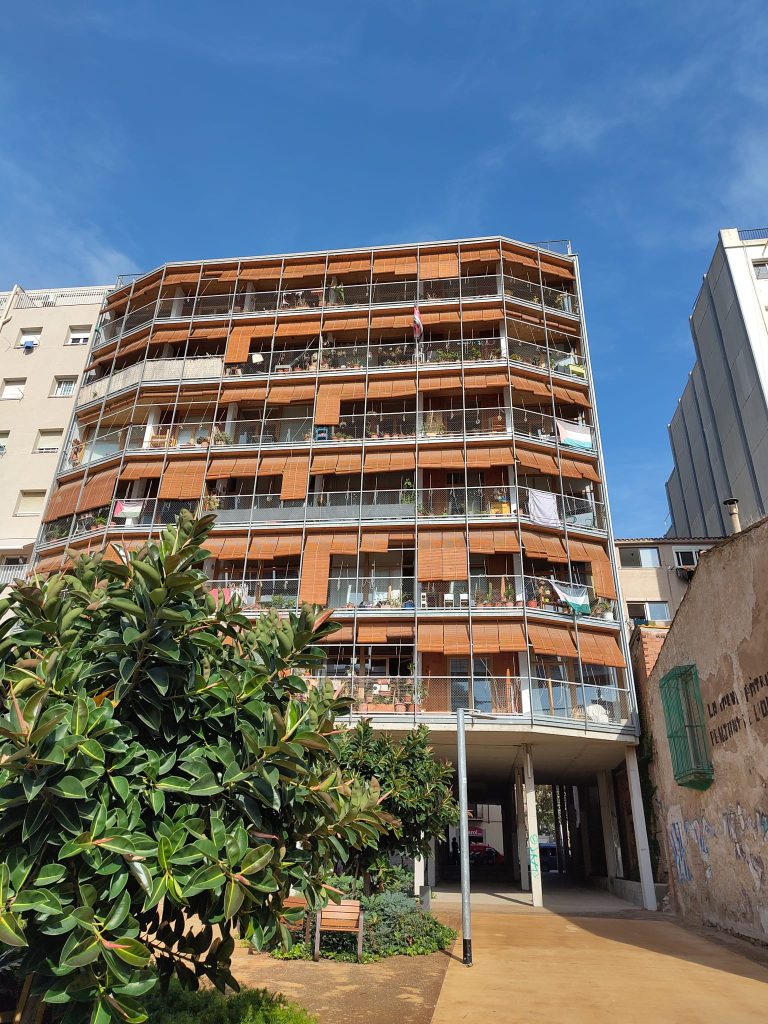
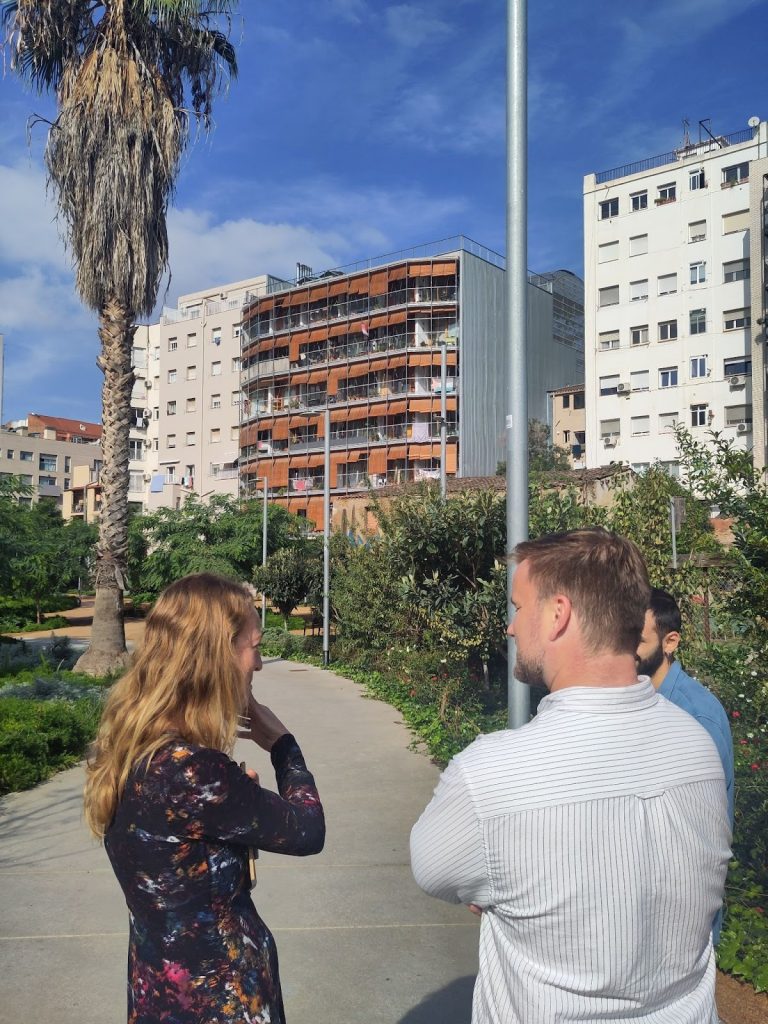
Site visits
The participants had a first life experience of two examples of how community led construction of the built environment not just creates more sustainable buildings, but built neighbours and social impacts within the values centring life and not profit within the Catalan social and solidarity economy.
The main insights of the visits are what can not be captured by reading about it, but by putting the body in such spaces; experiencing the construction details, the mundane stories, the errs and go about of locally applied just transitions.
Bloc4 flyer
La Borda flyer
Presentations and discussion
Public Community-Led Housing and Sustainable Transitions, Adrià Garcia i Mateu, Holon
General framing
Public community-led housing is emerging as a key climate and justice solution, linking social reproduction, housing rights, and ecological transition. The presentation positions cooperative and community-led housing as part of a transformative infrastructure within the broader agenda of just transitions — connecting the micro (community practices) and macro (institutional evolution). It ends by arguing for the need to articulate general ambitious visions to overcome the housing crisis, outlines 4 different housing futures in dispute today.
1. Context and diagnosis
Catalonia’s housing situation on the last decade
- Total housing stock: 2.7 million homes.
- Tenure structure:
- 44.3% ownership (no mortgage)
- 31.7% ownership (with mortgage)
- 22% rent
- 2.1% social housing
- 44.3% ownership (no mortgage)
- Economic indicators:
- €2,496/m² (average new build)
- €4,952/m² (in Barcelona)
- €1,577/m² (public housing)
- €2,496/m² (average new build)
- 5571 homeless people; 12,446 evictions/year; 58,930 people in housing exclusion.
- Housing costs are unsustainable for younger populations (119% rent-to-salary ratio).
Insight: The housing system in Catalonia is structurally unbalanced, with a systemic affordability failure and severe social exclusion
2. Catalonias’s cooperative housing ecosystem
Indicators of growth
- 1,200 homes, 66 communities, +41% growth (habitatge.coop, 2024) in less than a decade
- Barcelona is becoming a European reference in the cooperative housing niche.
Barriers and mechanisms
The presentation lists multiple structural economic, relational, temporal, and cultural barriers, with examples of how projects have addressed them:
| Barrier Type | Example Project | Mechanism |
| Access & affordability | Mur | Priority access to selling of existing building |
| Land & assets | Princesa | Public land/buildings lease |
| Construction financing | Titaranya, Ponent | Public or subsidy-based on upfront payment |
| Community finance | Xicoira | Community subsidies for upfront payment |
| Long-term security | Cal Cases | “Safety box” fund for monthly fee problems in payment |
| Participatory finance | La Borda | Community loans |
| Design inclusivity | Empriu, Renegà, Cal Tonal, Cal Blanxart, Balma, Closca, Walden XXI, Vida Inclusiva | Diversity of typologies (gender, intergenerational, origin, mental abilities, emergencies) |
Insight: The cooperative housing niche in Catalonia has become a laboratory of housing justice, experimenting with models that tackle financial, cultural, and relational inequalities simultaneously. But still, structural barriers have to be overcomed.
3. Niche practices and transformative potential
Based on transition theory (Geels, 2011; Meadows, 1999):
Community-led housing operates across micro, meso, and macro levels, engaging in:
- Building/refurbishing homes (material innovation)
- Strategising and creating new organisations (institutional innovation)
- Co-producing policies and lobbying (political innovation)
- Building and sharing visions (cultural innovation)
Insight: The movement is not only producing buildings but actively reconfiguring governance, operating as a socio-technical niche within the just transition framework.
4. The moment for housing and the futures in dispute
The presentation ends with arguing for a paradigmatic moment for housing, where the political centre who is in government is having housing in its main priorities.
It argues that beyond focusing on concrete socials or environmental problems and policy measures, there is a general conversation on visions to orient and align systemic efforts. For it outlines four emerging futures present in Catalonia that might resonate with other countries.
- A new ‘society of home- owners’ with a new state led plan for construction and soft mortgages for families and the recentralization of powers over housing from regions such as Catalonia.
- A platformization of housing, where a few owners in the form of a digital platform concentrate a mostly private rental park.
- A National Public Housing System of Catalonia, where the public cooperative community model is an important part of governance of the housing stock, where organised communities participate both in production and with the management of housing and land.
- A socialist revolution that ensures workers’ control of quality and free universal housing.
Final insights
- Public community-led housing is not just a growing alternative but a strategic lever for just and sustainable transitions.
- The Barcelona–Catalonia ecosystem is building a multilevel infrastructure of the commons, merging social innovation with ecological governance.
- The next step is institutionalising this niche without losing its transformative DNA — ensuring public policies enable, rather than absorb, community-led practices.
The connection between housing, care, and climate forms the foundation of a new socio-political paradigm for 2050.
Cooperative housing construction, Cristina Gamboa, LACOL
Dimensions of sustainability and sufficiency:
1. Social dimension
- User participation and local context as design drivers.
- Coexistence models and programmes adapted to diverse profiles.
- Public–community–private transition, exploring new institutional roles.
- Typological flexibility and adaptability of living spaces.
- Gender perspective integrated into design and management.
- New typologies and regulations suited to collective housing models.
2. Environmental dimension
- Awareness and shared values as a basis for habit change.
- Demand reduction and programme optimisation.
- Active and passive strategies, with the user playing an active role in energy performance.
- Construction systems aligned with environmental criteria.
- Monitoring and follow-up to ensure continuous improvement.
3. Economic dimension
- Cross-cutting approach, integrating both construction and life-cycle costs.
- Collective definition of programme and needs as a cost-saving strategy.
- Rethinking standards to adapt them to cooperative realities.
- Phased construction and self-construction as tools for cost reduction and empowerment.
Process and comparison
- Comparison between conventional and cooperative housing projects: degree of participation, phases of self-development, and community involvement.
- Self-promotion understood as a transformative process, redefining both professional and citizen roles.
Implementation
- Introduction of new measures, actions, habits, and routines translating the theory of “sufficiency” into everyday life and collective building management.
Final insight
Cooperative architecture not only builds structures, it builds relationships and systems of change. It serves as a tool for advancing sufficiency and community resilience, where the built environment becomes a catalyst for social and environmental transformation.
Barcelona Housing Policy, Eduard Cabré, IMHAB, Barcelona City Council
Overall goal
To strengthen a public, affordable, and sustainable housing policy in Barcelona through three main lines:
- Protect and prevent residential vulnerability.
- Increase the stock of affordable and social housing.
- Renovate and adapt the existing stock towards climate neutrality and social inclusion.
0. Context: housing situation in Barcelona
- Only 1.5% of housing stock is public (Catalonia: 3.3%; far below OECD average).
- 44.6% of the population spends more than 40% of their income on housing → high financial burden.
- Ageing population: 21% over 64; decreasing young population.
- Poor accessibility: 44% of homes without an elevator, up to 69% in some districts.
- Old, inefficient housing stock: 83% of buildings rated E or worse; limited insulation improvement due to heritage constraints and mild climate.
Insight: Housing policy must address affordability, energy vulnerability, and ageing simultaneously — moving towards integrated renovation and housing justice.
1. Protect, prevent and serve
Tools:
- Rent regulation.
- Rental vouchers.
- Tourist apartment regulation.
Strategy: to reduce private market pressure on vulnerable groups and curb touristification.
2. Increasing the social and affordable housing stock
2.1. Land policy
- Active use of municipal land to promote affordable rental housing.
- 100 ongoing projects (2024) → over 6,000 units, 30% for youth.
2.2. Construction innovation
- Industrialised construction (APROP, La Balma, etc.)
- Building time cut from 5 to 2 years.
- Cost and environmental impact reduction.
- Better quality, control, and efficiency.
- Building time cut from 5 to 2 years.
- Public procurement includes environmental criteria (≥30% CO₂ reduction during construction).
2.3. Development models
- Direct management (IMHAB): rental, leaseholds, relocations.
- Delegated development via land leaseholds to foundations, cooperatives, and public/private developers (Habitatge Metròpolis, INCASÒL).
Insight: Public–community collaboration and the active use of public land are key strategies to expand impact and consolidate housing as a common good.
3. Public housing management
Strengthened municipal capacity for housing development and management as the key to scaling up.
IMHAB operates as an integrated public housing agency, not just a promoter.
4. Renovation policies and climate transition
4.1. Renovation grants (2016–2023)
- 67,093 housing units benefited, €172M allocated.
- Focus on energy efficiency and accessibility improvements (elevators, façades, vulnerable areas).
4.2. Next Generation EU
- 8,700 dwellings (1.1% of stock) granted €100.5M in subsidies.
- Average energy savings: 56%, with subsidies up to 80% for top-performing projects.
- Combined upgrades: efficiency + renewables + accessibility.
- Average building year: 1945–1953 → ageing stock prioritised.
Insight: Renovation policy doubles as a climate mitigation and social equity policy. Ensuring its continuity beyond EU funding is crucial.
5. Stakeholders and governance
- IMHAB: main operator and coordinator.
- OHB (Barcelona Housing Observatory): data and analysis.
- Barcelona Housing Studies Chair: academic collaboration.
- Multi-level governance: city, regional, national, and EU alignment.
Insight: Barcelona’s housing policy forms an institutional innovation ecosystem, linking policy, research, and community.
6. Definition and models of social & affordable housing
- Social housing: targeted to very low-income households; rent tied to income percentage.
- Affordable housing (VPO): capped rents (8.8–10 €/m²); permanent affordability guaranteed by Law 17/2019.
- Combined with rent vouchers → effective costs of €200–400/month.
- Long-term financial sustainability: IMHAB retains 100% of rents.
Strategic reading: eco-social urban transition
- Green industrialisation → lever to reduce emissions and costs.
- Cooperative governance → decentralised, co-produced housing policies.
- Energy renovation + social inclusion → aligned with 2030 climate neutrality.
- Territorial and generational balance → priority for youth and elderly housing.
- Data-driven policy → monitoring, evaluation, and knowledge transfer.
Final insight
Barcelona is moving from a reactive housing policy to a structural, resilience-based housing system combining:
- The right to housing,
- The energy transition, and
- Institutional innovation.
It represents an emerging model of urban climate justice, where housing is both social and environmental infrastructure.